
What is a Knowledge Artifact
How real-world artifacts and fictional constructs helped shape the characters and world of 2065

Before I begin sharing excerpts from Knowledge Artifacts throughout June, I want to take a step back and explain the larger frame. This post will focus on how these artifacts came to be, what they are, and the role they play in both the novel and the writing process that shaped it. A second post will explore the related concept of knowledge shards.
Defining Knowledge Artifacts
A knowledge artifact is anything I’ve created that carries meaning, insight, or memory, especially when it helps flesh out the world of the novel or clarify a character’s perspective.
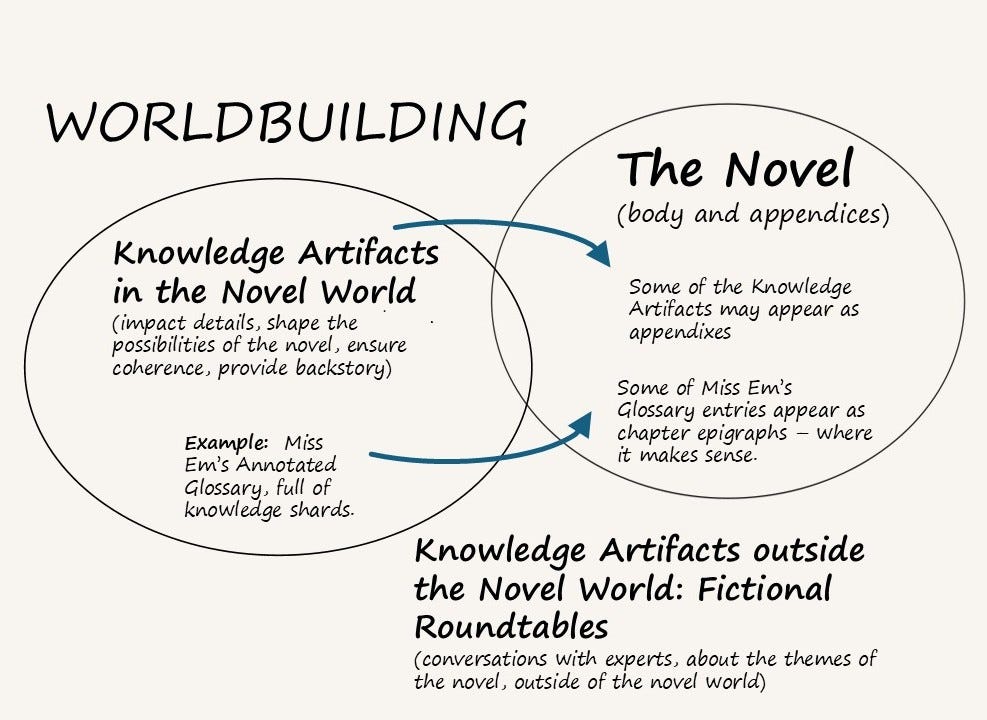
Some of these artifacts live inside the fictional world (like Miss Em’s Annotated Glossary). Others were tools I used to think through ideas during the writing process. This includes journal experiments, fictional research agendas, psycho-professional profiles, and a series of speculative roundtable conversations.
Not all artifacts will appear in the novel. But each one helped me figure out what kind of knowledge matters in 2065, and to whom.
In speculative fiction with complex worldbuilding, you sometimes find these elements in appendices: a map, a glossary, a timeline, a historical document. They offer readers orientation points.
Where the Idea Came From
Early on, I was looking for frameworks to help me think more clearly about the future. That’s when I came across the work of Stuart Candy and his use of “artifacts from the future”. These are objects designed to make speculative scenarios feel tangible.
That idea stuck. While drafting the novel, I started building my own kinds of artifacts—conceptual, textual, digital. These weren’t just background tools. Some of them became part of the narrative itself.
Some artifacts helped spark the idea for the novel. My personal vinyl collection and its digital catalog, for example, became part of the novel scaffolding. Another key artifact—still unrevealed—emerged from real life as well, projected forward into the world of 2065.
Revision as Artifact Accumulation
Many of the early artifacts were journal entries I used to get closer to one character’s voice. But those eventually became too much like me. As I revised, I had to remove myself and let her voice stand alone.
That’s when a flood of new artifacts arrived.
With each revision round, I had to become more precise about themes, technologies, and the vocabulary of 2065. I used generative AI tools to research speculative technologies and brainstorm terminology. That created a need for consistent definitions.
I began writing definitions for the terms I was creating. Some were short. Somet were expansive. All were grounded in the context of the novel.
Eventually, I turned that impulse into a larger fictional artifact: Miss Em’s Annotated Glossary.
It’s a hybrid document. Part glossary, part worldview. Characters refer to it sparingly. Readers catch glimpses. I use it as a reference while writing.
Whether or not the full glossary ends up in an appendix or companion document, individual entries have already made their way into the novel as epigraphs.
From Artifact to Public Fragment
Not all knowledge artifacts are suited for full inclusion in the novel. But many can be shared in other ways.
Throughout June, I’ll begin posting excerpts from Miss Em’s Annotated Glossary and related materials. These will be small, self-contained entries that I call knowledge shards.
Each shard offers a window into the cognitive and technological terrain of 2065.
Coming Next: What Is a Knowledge Shard?
In the next post, I’ll introduce the term “shard,” how I’ve adapted it for the world of the novel, and why these fragments matter.
It’s a term borrowed from gaming and technology, reimagined through the lens of speculative fiction and knowledge work.
Each shard is small, a fragment of a bigger whole. None is simple. They reward attention.